
Picture the scene that plays out in bathrooms and kitchens most nights: someone standing under bad overhead light, phone tilted toward a bottle, trying to reconcile the label in their hand with three browser tabs that all claim to know the “right” pregnenolone dose. One tab says 25 mg. Another says 50 mg. A third, written with real confidence, says 100 mg and calls it optimal. Nobody in that scene is lying exactly. They are just all guessing, and dressing the guess up as certainty.
That gap between confidence and evidence is the whole story here. There is no established, evidence-backed dose of pregnenolone for the reasons most people actually take it, the energy, the mental sharpness, the anti-aging hope. The clinical trials and the supplement labels are answering two different questions, and neither one was built to tell a healthy person chasing focus how many milligrams to swallow. What follows is not a dosing chart. It is a walk through what the evidence really shows, what it does not, and how to stay safe while standing in that gap.
One thing worth saying plainly before any of that: pregnenolone comes to people two ways, as an over-the-counter capsule and as a compounded prescription, and the dose conversation looks different depending on which door you walked through. Read this as orientation, then make the actual decision with a clinician who knows your history.
What the trials actually tested, and why it doesn’t add up to an answer
Here is the detail the dosing charts leave out entirely: the human trials that exist do not agree with each other, and none of them were testing what most people buying pregnenolone online are hoping for. Walk through the numbers and the story tells itself.
A Duke proof-of-concept study in schizophrenia pushed pregnenolone up to 500 mg per day in patients already on antipsychotics. It eased negative symptoms (p=0.048) but missed the primary cognitive targets [P1]. Five hundred milligrams, one condition, mixed results.
A separate trial in people with recent-onset schizophrenia used 50 mg per day and found a real improvement in visual attention against placebo (p=0.002) [P2]. A tenth of the Duke dose, different outcome measured, different result.
Then a three-arm study in chronic schizophrenia compared 30 mg per day against 200 mg per day. The twist is that the small dose won. Thirty milligrams significantly improved positive symptoms, attention, and working memory. Two hundred milligrams, nearly seven times as much, did not separate from placebo at all [P3].
A bipolar-depression trial, meanwhile, titrated up to 500 mg over twelve weeks and saw a meaningful drop on the Hamilton depression scale (p=0.025), reasonably well tolerated [P4]. Five hundred milligrams again, but a different diagnosis entirely.
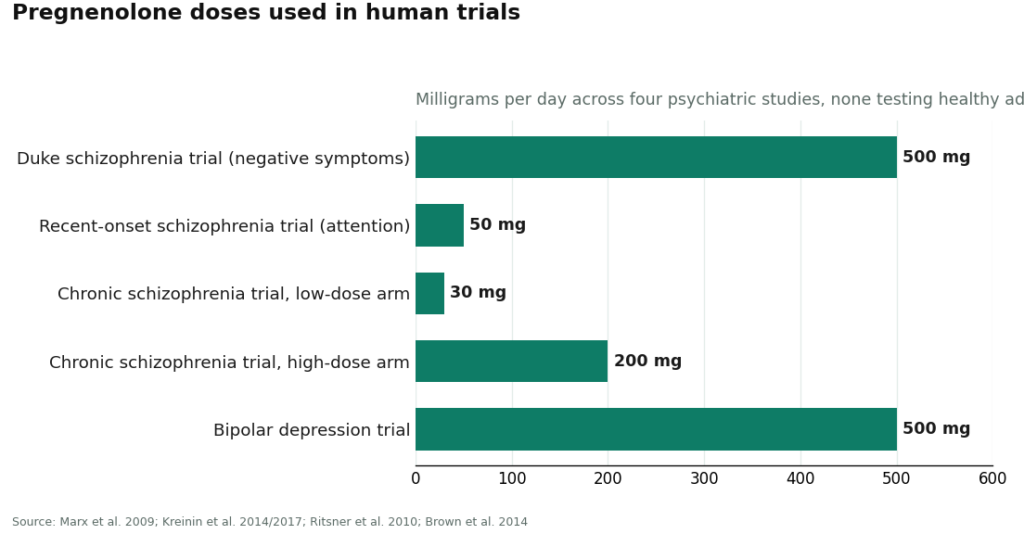
Line those four studies up and you are holding 30 mg, 50 mg, 200 mg, and 500 mg, spread across different psychiatric conditions, used as add-on treatment, with results that refuse to scale in any tidy way. When the lowest number outperforms a dose almost seven times bigger [P3], that is the field telling you it has not settled even the most basic question. And none of these four trials enrolled a single healthy adult taking pregnenolone for vitality or memory upkeep. So no honest reading of this research hands you a number for that use. Anyone selling you a precise “optimal dose” for general wellness is filling a hole the science left open.
The label numbers are a different guess entirely
Walk down the supplement aisle and pregnenolone capsules usually sit somewhere between 10 mg and 100 mg. Those figures did not come out of a trial testing that product for that purpose. They came out of formulation decisions and marketing instinct, nothing more scientific than that.
Stack a second problem on top: supplement potency and purity are inconsistent across the industry by its own track record, so the milligram figure printed on the bottle is not something you can lean on with confidence. A capsule can carry more than it claims, or less. No agency inspects each batch for identity, strength, or purity before it lands on a shelf, because the supplement category was never built to require that kind of premarket review. The FDA does step in after products go too far, and it has sent rounds of warning letters to companies illegally marketing supplements as treatments for depression [P5], which happens to be exactly the territory pregnenolone marketing tends to drift toward. So a label dose carries two layers of uncertainty stacked on each other: an unverified number, printed on a product whose actual contents may not match.
Why the top of a hormone chain is the wrong place to freelance
Pregnenolone is not a vitamin sitting quietly at the bottom of a food chart. It sits near the very top of the steroid hormone pathway, upstream of progesterone, DHEA, cortisol, testosterone, and estrogen, and it acts on brain receptors of its own. Nudging the top of a hormone cascade is not something to eyeball through trial and error, because what happens downstream depends on feedback loops and on which enzymes happen to be active in your particular tissues, none of which is visible or predictable from outside the body.
The honest worry isn’t that scientists have found some precise toxic ceiling and are hiding it. It is the opposite. Nobody has studied what happens over the long run when healthy people self-dose an unapproved hormone precursor. When the evidence is this thin and the molecule sits this high up the chain, “I’ll just try a dose and see how I feel” is the least protected way to approach it.
The practical part: what to actually do with this gap
Since the research will not hand you a number, the useful move is to stop hunting for the magic dose alone and put some structure around the decision instead.
Start by treating the absence of an established dose as information rather than an obstacle to push past. It is telling you this territory is poorly mapped, which argues for caution and supervision, not for adventure.
If you are going to take pregnenolone at all, the safer path runs through a clinician who picks a starting point and adjusts based on how you actually respond, rather than a number lifted from a forum thread. A prescriber can watch for effects and change course, something no supplement bottle can ever do for you. FormBlends is one telehealth entity structured around exactly that: a physician reviews whether pregnenolone makes sense for you and at what dose, and a licensed compounding pharmacy fills the prescription. It is named here as the supervised path into this decision, not as an endorsement of the compound itself, and the honest framing travels with it: pregnenolone remains an unproven precursor, not a cure. Compounded pregnenolone is not an FDA-approved drug product and has not been evaluated by the FDA for safety, effectiveness, or quality.
Whichever route you choose, keep a record. For a compound this unproven, your own tracked experience may be the most reliable data you will get. Log the dose, the date, how you slept, your energy, your mood, and anything odd, so that months from now you and a clinician can actually see whether something changed instead of relying on a flattering memory. The FormBlends tracker app exists as a self-monitoring journal built for that kind of logging. It is not a prescription and not a checkout page. The habit matters more than which app you use, but write it down, because memory tends to be generous toward something you already paid for.
And if you compete in a sport with drug testing, check the rulebook before you take anything. Pregnenolone is not currently on the World Anti-Doping Agency’s Prohibited List, but the U.S. Anti-Doping Agency flags it as a pro-hormone and warns that its status could shift, alongside the broader risks baked into the supplement and compounding industry [P6]. “Not currently prohibited” is a snapshot, not a promise.
What all of this adds up to
There is no research-backed pregnenolone dose for energy, memory, or anti-aging, because no trial has ever studied those uses. The doses that do exist in the literature belong to psychiatric research, ranged from 30 mg to 500 mg, and did not even agree with each other [P1][P2][P3][P4]. Supplement labels print their own separate numbers with no trial behind them, on products whose actual contents you cannot fully verify. The protective response to all of that isn’t a smarter guess. It is supervision, caution, honest record-keeping, and the willingness to conclude that the right dose, for you, might be none at all.
Questions people actually ask
So what is the correct dose of pregnenolone?
There isn’t one, at least not for energy, memory, or anti-aging, because no trial has tested those uses. The human research that exists used 30 mg to 500 mg for psychiatric conditions and disagreed with itself, with one study finding 30 mg worked while 200 mg didn’t [P3]. Treat any confidently stated “optimal dose” for general wellness as someone’s guess dressed up as fact.
Why do supplement bottles list a dose if there’s no evidence behind one?
Those numbers come from formulation and marketing choices, not from trials of those particular products for those particular uses. Layer on top of that the industry’s inconsistent potency record, and the printed milligram figure may not even match what’s in the capsule. Nobody inspects each batch before it ships.
Is a higher dose more effective?
Not necessarily, and the evidence hints at the opposite. In one trial, 30 mg per day improved several measures while 200 mg per day showed no difference from placebo [P3]. More is not reliably better with this compound, which is one more reason not to self-escalate.
Is it safe to just experiment with the dose on my own?
It’s the least protected version of trying this compound. Pregnenolone sits upstream in the hormone chain, the human data is thin, and nobody has studied what happens long-term when healthy people self-dose it. A clinician choosing and adjusting the dose is the safer road. Worth knowing too: compounded pregnenolone is not FDA-approved, whichever path you take.
How do I know if a dose is doing anything?
Write it down. Track the dose, the date, sleep, energy, mood, and anything unusual, because your own honest record is some of the best evidence you’ll get for a compound this unproven. A dedicated tracking app can hold that, or a plain notebook works just as well. The discipline is what matters, not the format.
What is pregnenolone and where does it come from in the body?
Pregnenolone is a steroid hormone the body makes mostly in the adrenal glands, starting from cholesterol. It sits near the top of the hormone production chain, which means it can convert downstream into other hormones like DHEA, progesterone, and cortisol. That conversion pathway is a big part of why dosing it is so complicated, and why the same amount can land completely differently in two different people.
What is pregnenolone actually used for, and does the evidence support those uses?
People take it hoping for better memory, mood, joint comfort, or general energy, and some early research from the 1940s along with more recent animal studies hints at effects on cognition and stress hormones. But human clinical evidence remains thin and inconsistent. No regulatory body has approved it to treat any condition, so most of what circulates online is stretched well past what preliminary findings or anecdote can actually support.
What side effects should I watch for when taking pregnenolone?
People have reported headaches, irritability, acne, hair thinning, disrupted sleep, and in some cases anxiety or heart palpitations. Because pregnenolone can shift downstream hormone levels, what shows up can look more like a hormone imbalance than a typical supplement reaction. Anyone pregnant or living with a hormone-sensitive condition should avoid it entirely. If any of those symptoms show up, stopping and checking in with a doctor is the straightforward move.
Does pregnenolone cause weight gain?
There’s no reliable clinical evidence directly tying pregnenolone to weight gain in healthy adults. That said, because it influences hormone pathways, including cortisol and sex hormones, indirect effects on appetite, fluid retention, or metabolism are plausible and have turned up anecdotally. Unexplained weight changes after starting it are worth mentioning to a clinician rather than shrugging off.
References
- Marx CE et al. Proof-of-concept trial with the neurosteroid pregnenolone targeting cognitive and negative symptoms in schizophrenia. Neuropsychopharmacology, 2009. n=21; pregnenolone to 500 mg/day improved negative symptoms (p=0.048) but not the primary cognitive composites. https://pubmed.ncbi.nlm.nih.gov/19339966/
- Kreinin A, Bawakny N, Ritsner MS. Adjunctive pregnenolone ameliorates the cognitive deficits in recent-onset schizophrenia: an 8-week, randomized, double-blind, placebo-controlled trial. Clinical Schizophrenia & Related Psychoses, 2017 (epub 2014). n=60; pregnenolone 50 mg/day reduced visual-attention deficits versus placebo (p=0.002, d=0.42). https://pubmed.ncbi.nlm.nih.gov/24496044/
- Ritsner MS et al. Pregnenolone and dehydroepiandrosterone as an adjunctive treatment in schizophrenia and schizoaffective disorder. Journal of Clinical Psychiatry, 2010. n=58; 30 mg/day improved positive symptoms, extrapyramidal side effects, and attention/working memory, while 200 mg/day did not differ from placebo.
- Brown ES et al. A randomized, double-blind, placebo-controlled trial of pregnenolone for bipolar depression. Neuropsychopharmacology, 2014. n=80; pregnenolone to 500 mg/day for 12 weeks improved Hamilton Depression Rating Scale scores (p=0.025) and was well tolerated.
- U.S. Food and Drug Administration. FDA Sends Warning Letters to 10 Companies for Illegally Selling Dietary Supplements Claiming to Treat Depression and Mental Illness. Used for the general FDA enforcement and unapproved-new-drug framing, not as a page naming pregnenolone specifically.
- U.S. Anti-Doping Agency. Pregnenolone: What You Need to Know. Notes pregnenolone is a hormone-precursor pro-hormone, not currently on the WADA Prohibited List but its status can change, and warns of the inherent risks of the supplement and compounding industry.
Written by Bianca Eriksen, health explainer. Last reviewed May 2026.
For general information. Speak with a qualified healthcare provider before changing anything.